

Year 10 Media students will soon be undertaking their long Component 1 Supervised assessment in later this month. This is the first of three BTEC summative assessments which will count towards their final grade.
Obviously we try and do things a bit differently at More House in order to best support all the boys and their individual needs – however when it comes to formal and supervised assessments like this there are some strict guidelines we must follow.
Hopefully this guide – for students, parents and tutors – will give you a clear understanding of what’s expected during this assessment , and how we can all prepare and support each other, students, parents and teachers alike – so that this assessment can be as productive and stress-free as possible.
As you scroll through this guide, I will refer to what the BTEC guidelines say, share examples of what student work may look like, and also share links to outside sources of information that may be useful.

What is Component 1?
For much of this explanation, I will refer to the BTEC Teachers guide, as it is actually fairly clear & straightforward. For a quick summary, Component 1 is a long topic that explores the many and varied different types of media products we use, share and interact with – films, TV shows, podcasts, games and websites. It looks at how they relate and overlap with one another, and very importantly, how different audience types consume them.
It is split into two learning aims – A and B. Learning Aim A is about exploring Media products in general, and Learning Aim B looks more specifically at how and why media products have been created, and what audiences use them.
It ends with the summative assessment – ( Called a PSA – Pearson Set Assignment). This is basically a set theme that is picked by BTEC and sent to the teacher ahead of time. It is split between two long tasks, 1 and 2. The first is a research based task lasting 3 hours, the second is a longer, more in-depth essay type task lasting 7 hours across as many lessons.
It is the most theoretical of the components in the Media BTEC, and the assessment does not specifically require the boys to plan or make anything practical, like a video.
Instead, it is a more essay-based exploration and discussion about different media types in general – with a lot of focus on comparisons, evaluations and opinions.
The BTEC Guide says this:
The key purpose of this assessment is for learners to demonstrate their application of knowledge and understanding of different kinds of media products, how production techniques are used to create them and how they are created for different purposes and audiences.
The timing of the assessment is approximately 10 hours of supervised assessment.
In this component, learners will be introduced to a wide range of different media products. Exploring historical media products, defined as pre-2000, chosen by the teacher will enable learners to experience seminal or pivotal examples of media production.
Although learners should be introduced to remarkable, innovative and influential media products that are new to them (as they are likely to have been made before the learners were born), they should also be encouraged to build on their existing knowledge of contemporary media products, defined as post-2000, by investigating media products that they currently enjoy.
This approach should also broaden the range of media products selected for study, as it is likely to include media products created by different types of media producer, aimed at different audiences and consumed on different platforms in different ways.

Researching Media
One of our key areas of focus is to learn how to research media in-depth, and understand the difference between primary and secondary sources , and what bias and validity mean. The first task in the assessment asks students to specifically research Media based on the specific theme – so these skills are invaluable.
The BTEC guide says this:
Learners will need to use primary and secondary research sources to help develop their understanding of media products and media practice and to provide supporting evidence for their ideas and arguments. Teaching and learning activities on how to use primary sources could be delivered when learners are directed to select primary sources at specific points in the delivery of the component. Teachers should discuss how to assess the validity and reliability of secondary sources and how to reference the work of others with learners. Teachers could create a list of useful, valid and reliable secondary sources as a shared resource, which learners could add to.

Understanding media Producers and Audiences
This is a key focus of component 1, and something that is new to many students when they start in year 10. Trying to keep connecting a lot of these concepts together – like understanding the links between WHO makes the media and HOW/ WHY it influences audiences can be a big challenge to some students.
BTEC explains this focus here:
The relationship between media products, audiences and purposes should be explored from the perspective of both the media producer and the audience. When investigating the context of production, learners should be directed to consider the type of media producer, their ethos, motivations and aims, and how different media products fulfil their purpose through their production values, participants, content, distribution, synergy and marketing.
When investigating audience interpretation, learners could work together to research the key points of different audience theories, such as passive audience theory, reception theory, audience engagement theory, and uses and gratification theory, as they need to be aware that:
- audiences can be directly influenced by the media (media effects)
- media producers encode preferred readings into media products but audiences will respond to the same media product in different ways, e.g. preferred, negotiated, oppositional readings
- audiences passively or actively consume media products depending on the situation, such as where they are, who they are with and the level of audience involvement, e.g. primary, secondary, tertiary engagement
- audiences actively choose and engage with media products for specific reasons, e.g. the need for information, diversion (entertainment or escapism), personal identity, social interaction.
Keeping track of your Media
All of the students have a simple document called a Media Research log saved in their Teams Folder. This is a table to help remind them of all the films, TV shows, games etc they have interacted with. For many of us this is hard to keep track of, but its extremely beneficial to have a range of relevant examples to talk about in the assessment – s its important that this is kept as up to date as possible. it might be worth checking to see if its been filled in lately.
What does the assignment look like?
Obviously I cant show you what each set assignment will be for each student every year – however BTEC do provide a sample which is available on their website, that i can share here:


An example of Task 1 (Learning outcome A)
As you can see from the examples above, task 1, lasting 3 hours is a research based tasks where the boys must gather evidence – based on the theme in the assignment (the example is ‘Technology’ )
All the work should be saved in a Task 1 folder, and kept together, and be labelled clearly.
To start with, I would suggest creating a Mind Map of lots of possible areas of research is a good first step. This will help focus what we are doing so we dont get overwhelmed.
I use a free online graphic design program called Canva to do this:
boys can set up a free full account using their More House emails.
Here’s what an example mind map, based on Technology could look like:
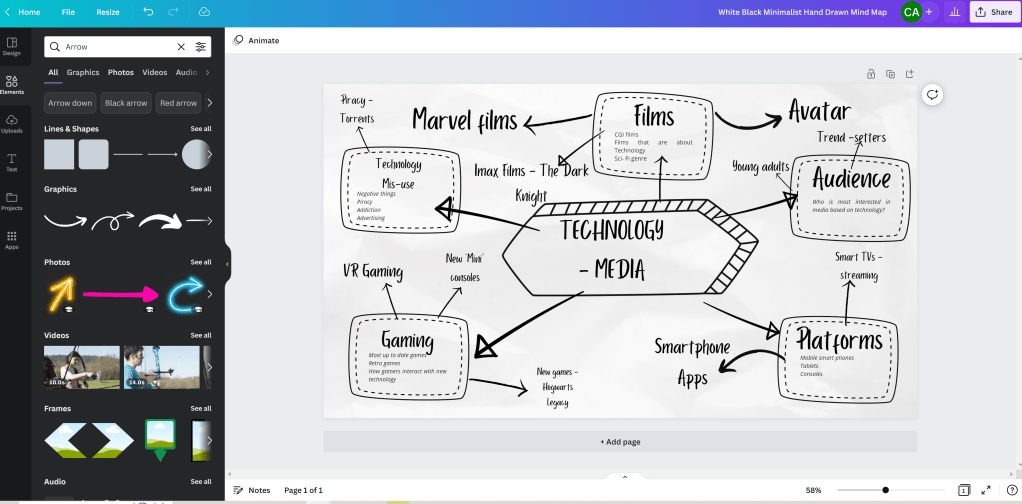
The next step, once this is saved, would be to start investigating each of the mind map ideas, finding examples of media linked to each, and commenting on them.
The idea will be to try and find interesting links between them, that you can form into an argument or discussion for Task 2, later on.
I suggest recording this evidence in a powerpoint (though BTEC say you are free to use whatever available app you find easiest.)

You have 3 hours to spend on Task 1 – this will be about three and a half lessons – remember, you can only work on this whilst in school – you can’t take it home.
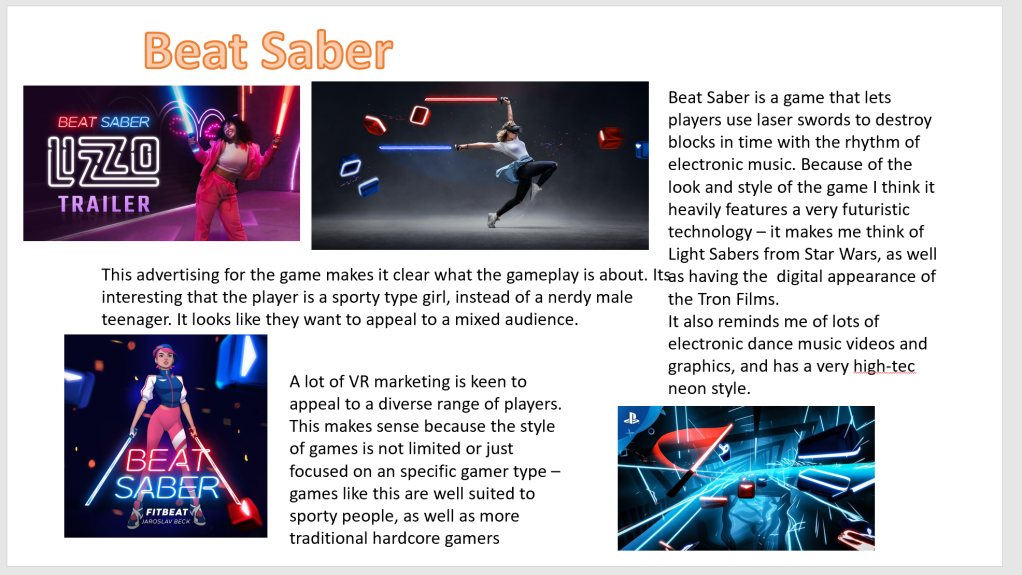
As you investigate further you should start to make more in-depth observations and comments, and make sure you are linking your research on each media product to a variety of themes such as audience, representation, purpose, platform etc – like this example:
Here’s what the BTEC Marking grid looks like for Task 1 / Learning Aim A:

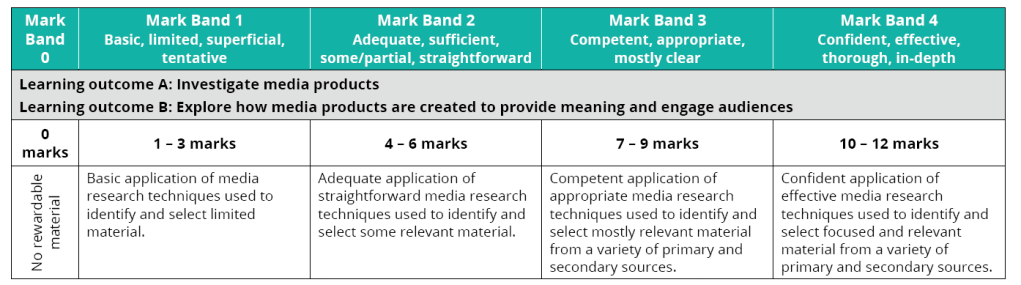
Looking at this criteria, we can maybe assume that the student work from the examples above is roughly in line with MARK BAND 3 – its is COMPETENT and makes APPROPRIATE LINKS, as well as showing GOOD UNDERSTANDING.
The aim throughout Task 1 would be to research as many relevant Media products as possible, whilst developing a solid idea for a discussion or argument about the theme for Task 2. I think in 3 hours it would be reasonable to try and aim to complete anywhere between 4 – 8 detailed powerpoint slides.
Next – Task 2 and Learning Outcome B
This is the second task, lasting 7 hours of lesson time. It looks like this:
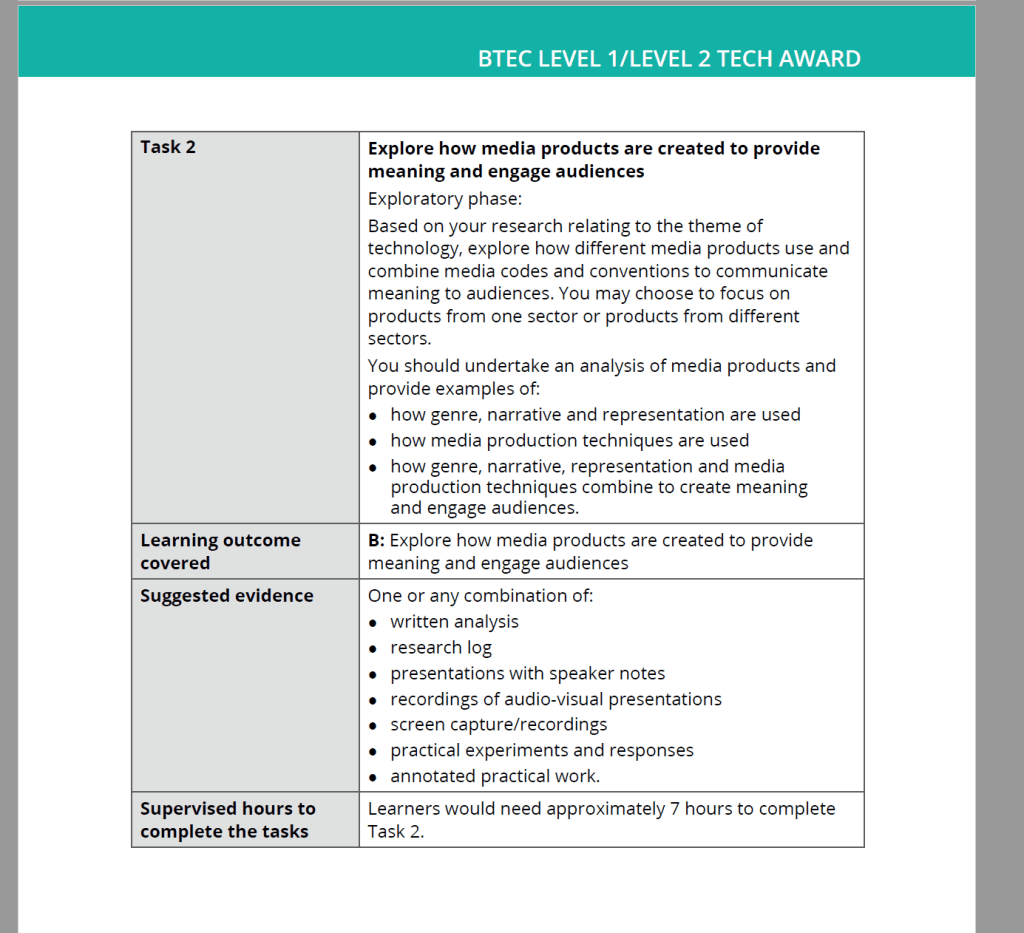
Now obviously we have spent a lot of time learning and discussing all the different codes and conventions used in Media – and most importantly of all learning to voice our opinions on the examples we have explored.
Now is the time to put these skills to the test.
The BTEC guide explains this learning outcome B like this:
Learners may focus on media products from one sector, or media products from different sectors, when responding to Learning outcome B, which allows for a wider range of products to be considered in relation to the learners and the programme.
Learners should be encouraged to select media products that will best enable them to engage with the component content, i.e. genre, narrative and representation and how media production techniques combine to create meaning and engage audiences.
Learners will need to compare how different media products, such as examples of historical, contemporary, sub-genre or hybrid media products, manipulate generic conventions to engage the audience. Learners should investigate how the common characteristics of the selected genre – as well as any characteristics from other genres and elements of originality – have been used in each media product and the effect on the audience.
Learners also need to compare how the use of narrative features in each media product creates meaning for the audience, including storytelling (in fiction and/or non-fiction), narrative structure, point of view, characterisation, themes/symbols/motifs, setting and mode of address. Learners should investigate how each narrative feature has been used and its effect on the audience.
To develop their understanding of how media products construct representations of reality, learners should explore how media products represent people, places, issues and events from a particular point of view or perspective, how media products position the audience, stereotyping and its consequences, under-representation and misrepresentation, positive and negative representations, and the effect on the audience.
Learners will need to compare how the combined use of production techniques in their chosen media products contributes to the meaning, e.g. shaping the audience response, creating a specific tone/mood/atmosphere, developing characters, constructing the story.
Organising Task 2
As this is a very long 7 hour essay or report it would make sense to do some planning first, based on your research from Task 1.
It would be a good idea to use a blank word document (again, any app could be used) and create some bullet point notes, like this:

Once this is done its time to start putting in the content for your essay. This is the sort of look we are going for :
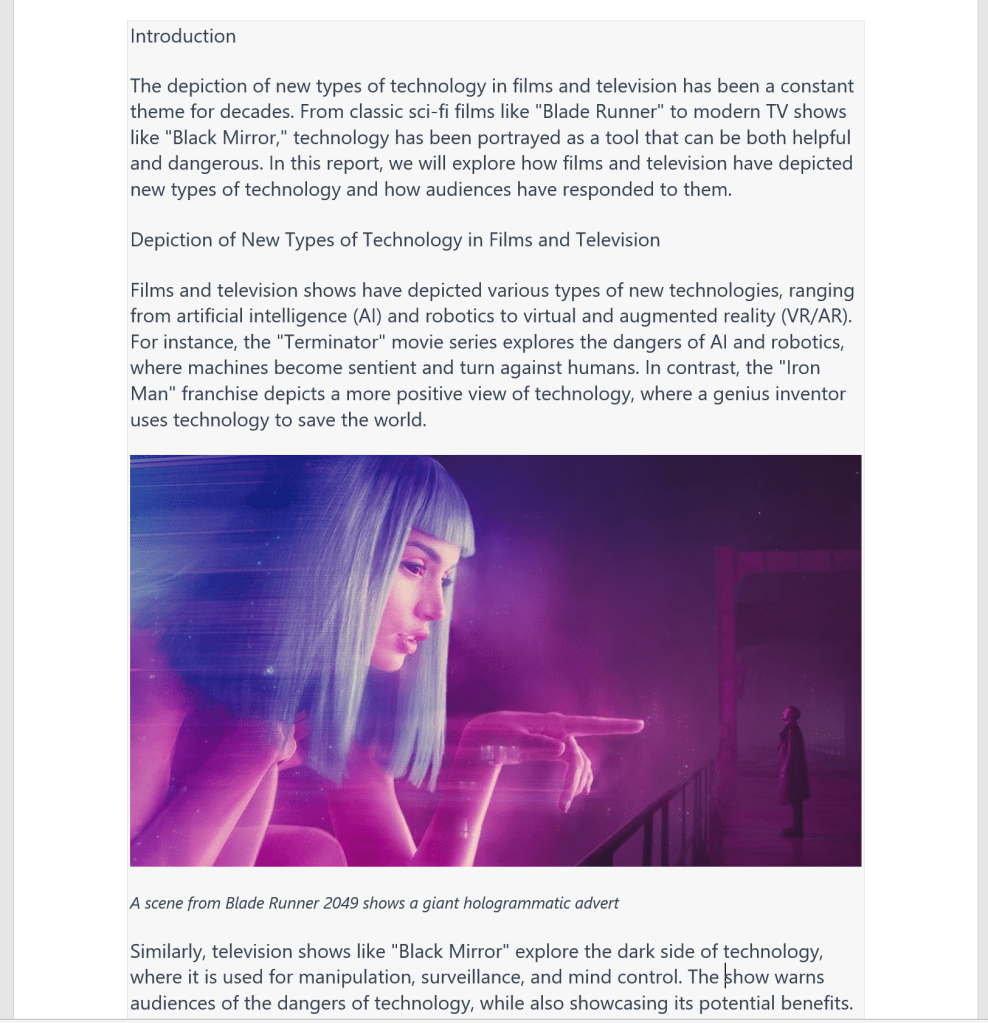
We have already practiced this in lesson. It can be challenging, but we have to get into the habit of using PEEL ( we do this in English lessons too) there are lots of PEEL resources out there – here are some we use in school:


So we have 7 hours in total to complete Task 2 – ideally this should end up looking like a long report, perhaps 7 – 10 pages long, and a mix of text, images, links and other graphics.
This should all be saved in the same folder, as it will need to be handed into BTEC at the end.
The mark scheme for Task 2 or learning aim B looks like this:

This is just one part of the markscheme, but hopefully gives you the gist of it.
BTEC Restrictions
Because this is a formal assessment there are some restrictions imposed by BTEC on how the students can complete their work. These are very clear and the school must adhere to them closely. The guidance given to teachers is as follows:
To maintain security during supervised conditions:
- learners must not be given writing frames, prepared formats, templates or any other forms of scaffolding.
- all work must be completed independently by the learner under the monitoring and supervision
conditions outlined in the levels of control - work must be produced in response to the assignment and no work completed during teaching
can be used or adapted for this purpose - guidance or support can be given to learners only in order to clarify:
o the requirements of tasks
o the evidence they need to produce
o any resources they are allowed to access - learners cannot receive any guidance or instruction about how to improve work to meet mark
bands or solutions to questions or problems in the tasks - learners may produce notes as part of their research sessions and these notes can be used to
generate their final work. Learner must not however be given any support or feedback in writing
or editing notes - appropriate steps must be taken to prevent plagiarism and/or collusion through supervision
and regular checks of work as it develops.
More help and resources
At the moment the new BTEC Media Techa Award and Component 1 are still very new, so there’s a very limited amount of help online for it. However there are some trusted places we can visit to get some good all-round general media help, and i’ve included links to them below.
First is a link to The Media Insider – an excellent resource for media students, his videos are very accessible, and as he’s a teacher he explains it all in a way that is easy to understand:
Next, Mrs Fisher is another excellent media teacher with a fantastic youtube channel. She teaches GCSE and A Level, but there’s still a lot that’s relevant for BTEC students too. This example is abut discussing a movie poster, which is something that we can do in our assessment:




 Visual Arts